

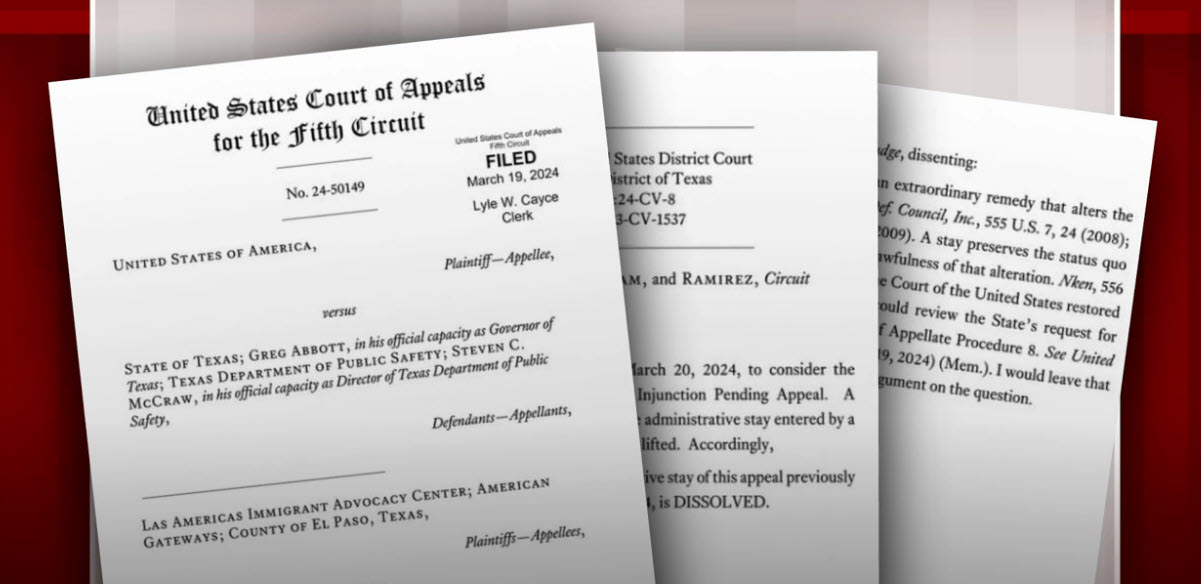
A federal appeals court is at the center of a contentious debate over Texas’ immigration law, which would empower local law enforcement to arrest individuals they suspect are in the country illegally. The court’s recent decision to put the law back on hold has sparked intense reactions from both sides of the argument.
The hearing at the Fifth Circuit Court of Appeals in New Orleans saw heated arguments from attorneys representing Texas and the Justice Department. Texas Solicitor General Aaron Nielson defended the law, emphasizing its necessity in addressing what he described as a “crisis” of illegal border crossings. He argued that empowering local police to make such arrests is crucial for the state’s security.
On the opposing side, Justice Department attorney Daniel Tenny contended that Texas’ efforts are unconstitutional, emphasizing that immigration enforcement falls under the federal government’s exclusive jurisdiction. Tenny raised concerns about potential chaos and legal complications that could arise if the law were to be implemented.
The court’s decision to keep the law on hold reflects the complex legal and political dynamics surrounding immigration policy in the United States. The debate extends beyond legal interpretations to encompass broader questions of federal-state relations and border security strategies.
In a related development, a panel of judges at the 5th US Circuit Court of Appeals voted against an earlier ruling that had allowed the law, known as SB 4, to take effect. This decision adds another layer of uncertainty to the future of Texas’ immigration enforcement measures.
Texas Governor Greg Abbott, a staunch supporter of the law, expressed disappointment at the court’s ruling. During a summit, Abbott reiterated the importance of the law for Texas’ safety and criticized the Biden administration’s handling of border security.
The ongoing legal battle underscores the complexities and challenges inherent in immigration policy, highlighting the need for comprehensive and coordinated approaches at both the state and federal levels.

