

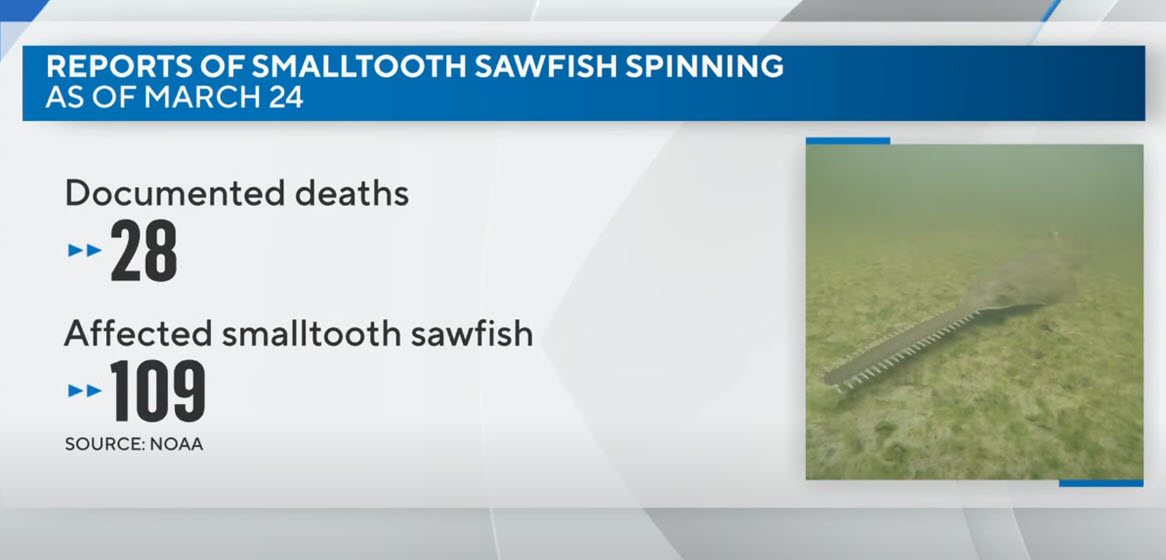
Researchers and experts from various institutions continue to investigate the perplexing phenomenon of fish spinning erratically in the waters of the Florida Keys. One particularly concerning aspect is the disproportionate impact on smalltooth sawfish. While the exact cause remains elusive, there are positive developments in unraveling this mystery.
According to Gil McRae from Florida Fish and Wildlife, recent investigations have ruled out red tide and low dissolved oxygen as causes of the unusual fish behavior. Additionally, the Department of Environmental Protection’s analysis has not detected any of the 250 pollutants that could be considered problematic. These findings suggest that the event may be linked to a naturally occurring species of algae that produces low levels of neurotoxins.
The Department of Health has provided reassurance by stating that there is no immediate risk to human health associated with this phenomenon. This news comes as a relief to residents and tourists who have been observing the unusual behavior of fish in the area.
One promising development is the potential release of an 11-foot sawfish that has been under recovery at the Mote Marine Laboratory in Sarasota. This indicates that some affected marine life may be recovering and returning to normalcy.
Gil McRae also notes that the number of reported cases of spinning fish and dying sawfish has been decreasing over the past two weeks or so. This positive trend suggests that efforts to understand and address the issue are yielding results, although the precise mechanism causing the phenomenon is still being studied.
Researchers from around the world are collaborating to investigate this mystery further. Their focus is on understanding the role of the algae species and its neurotoxins in affecting marine life in the Florida Keys. By identifying the root cause, scientists aim to develop strategies to mitigate and prevent future occurrences of such phenomena.
As investigations continue and scientific knowledge grows, there is optimism that the mystery of spinning fish and dying sawfish in the Florida Keys will be solved, leading to better conservation and management practices for marine ecosystems in the region.

