

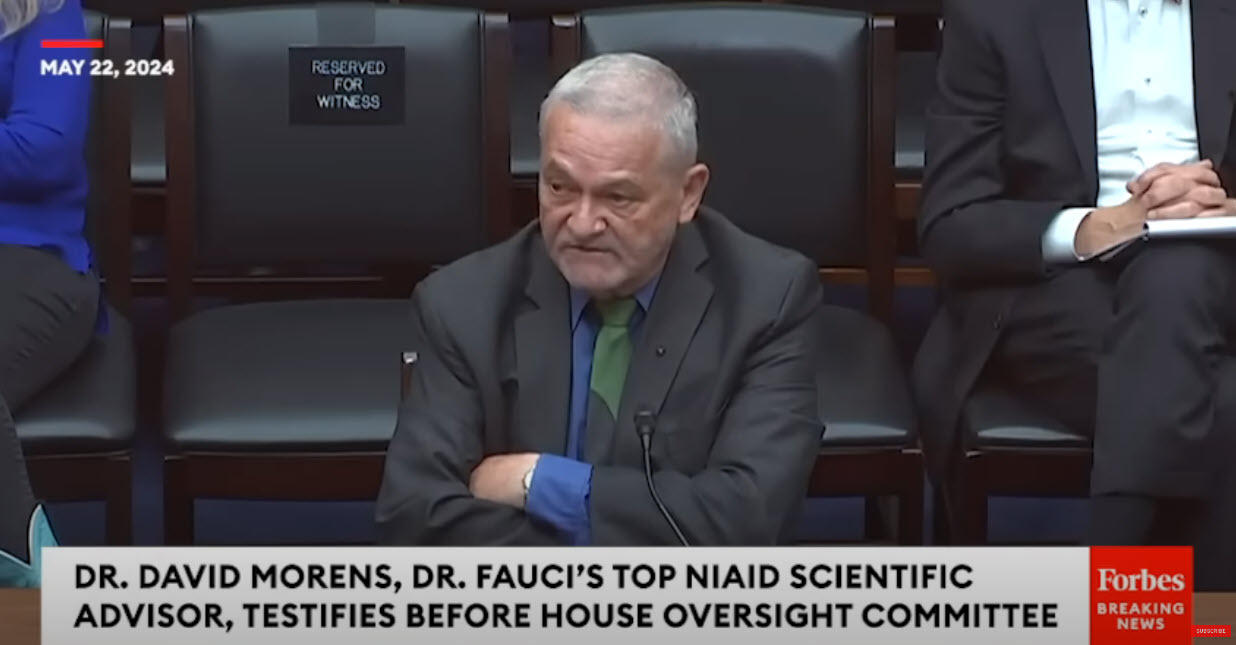
Dr. David Morens, a former top advisor to Dr. Anthony Fauci, is facing intense scrutiny from Republican lawmakers over potential U.S. links to the Wuhan Institute of Virology. The hearing, held today, delves into allegations that Morens may have deleted critical emails—referred to as “smoking gun” evidence—related to the origins of the COVID-19 pandemic.
Republicans on the committee are pressing Dr. Morens about his involvement and knowledge of any U.S. tax dollars that might have been funneled into the Wuhan lab. The Wuhan Institute has been at the epicenter of controversy, with ongoing debates about whether it played a role in the creation or release of the COVID-19 virus.
The hearing focuses on whether the U.S. government, possibly through indirect funding, supported research at the Wuhan Institute that some speculate could have led to the virus’s creation. This theory has been a point of significant political and scientific debate since the pandemic began, with various reports suggesting different origins for the virus.
In his testimony, Dr. Morens denies any wrongdoing and insists that any deleted emails were routine and not part of a cover-up. He emphasizes that the emails in question were not relevant to the pandemic’s origins and that there has been no direct evidence linking U.S. funding to the creation of the virus. Morens highlights the collaborative nature of global scientific research, which often involves sharing data and resources across borders.
The allegations against Morens are part of a larger inquiry into the transparency and accountability of government agencies in managing and responding to the COVID-19 crisis. The hearing also reflects broader geopolitical tensions between the U.S. and China, with the Wuhan Institute often symbolizing these strained relations.
The investigation into the origins of COVID-19 continues to be a contentious issue. Multiple agencies, including the World Health Organization, have conducted or are conducting probes to determine how the virus emerged. The U.S. government has also launched its investigations, with mixed findings and ongoing debates.
The hearing has garnered significant public attention, with opinions divided along partisan lines. Some view the scrutiny of Morens as a necessary step towards transparency and accountability, while others see it as a politically motivated attack with little basis in scientific evidence.
As the hearing progresses, it remains to be seen what concrete evidence will emerge and how it will impact the understanding of the COVID-19 pandemic’s origins and the future of international scientific cooperation.

