

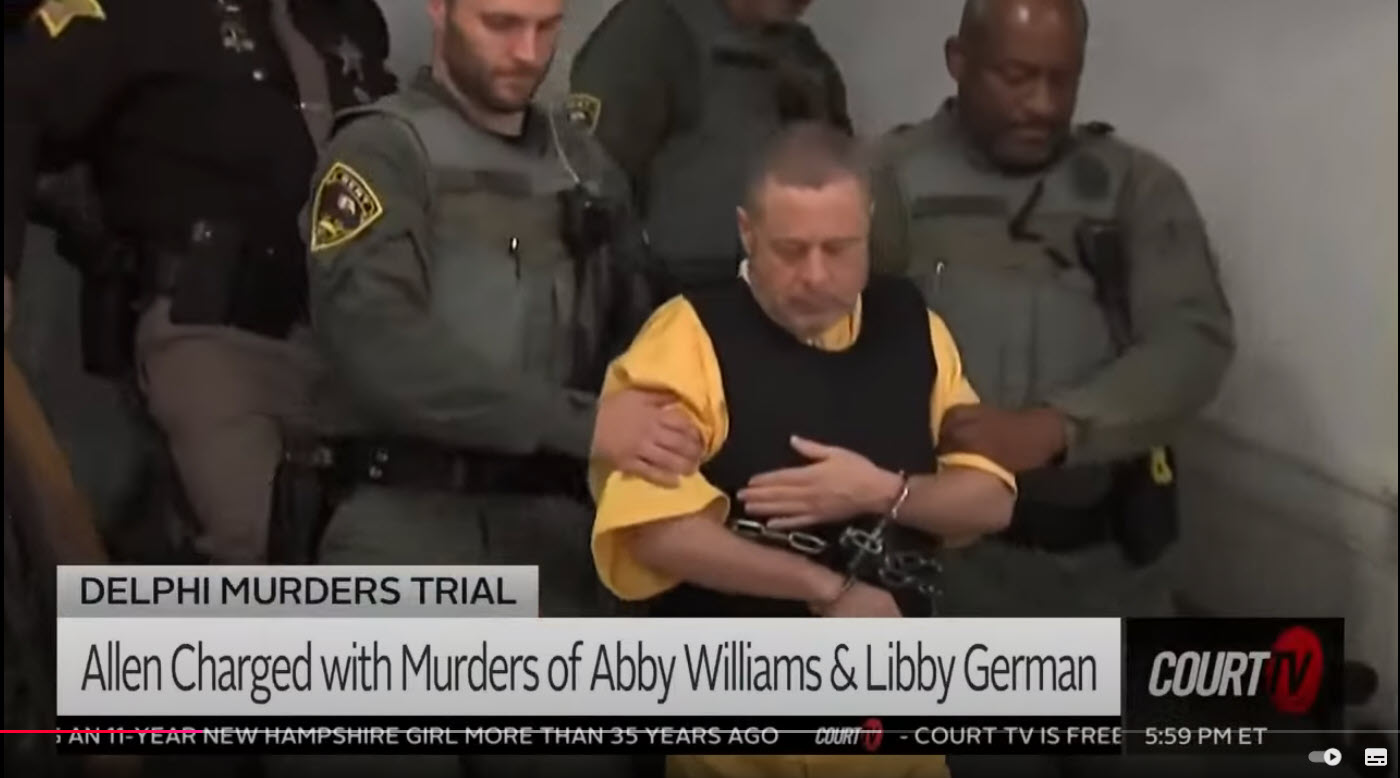
The trial of Richard Allen, the man accused of murdering two teenage girls in Delphi, Indiana, resumed today, with jurors examining pivotal evidence and hearing Allen’s recorded interrogation. Allen is charged with the 2017 killings of 13-year-old Abigail Williams and 14-year-old Liberty German, whose bodies were found near a hiking trail in the small Indiana town. After years of investigation and speculation, Allen was arrested in 2022 following the emergence of new evidence. The case has garnered significant national attention, becoming the subject of numerous true-crime shows.
A crucial element of this week’s proceedings includes the jury’s review of Allen’s police interrogation. Defense attorneys have emphasized the importance of letting the jury hear from Allen directly through these tapes, asserting that his responses may provide critical insights into his character and the defense’s claim of his innocence. Prosecutors, on the other hand, argue that the tapes reveal inconsistencies and unusual behavior, which they believe cast suspicion on Allen.
The trial took another turn with testimony from Stacy Bozinovski, a forensic scientist and DNA analyst with the Indiana State Police. Bozinovski conducted extensive DNA testing on various items collected from the crime scene, including the victims’ clothing, blood samples, and a cartridge found near the bodies. She reported that no DNA evidence links Allen directly to the crime scene. Bozinovski confirmed finding DNA from Libby German and Abby Williams on several samples tested; however, the DNA of other individuals, including a male profile unrelated to Allen, was also detected, though she explained this could result from environmental factors or indirect transfer.
A notable aspect of Bozinovski’s testimony addressed a cartridge recovered from the scene. Despite initial hopes it might hold incriminating DNA, Bozinovski stated the cartridge had an insufficient DNA quantity for analysis, a result she described as common due to challenges in extracting usable DNA from such items. Additionally, no forensic evidence indicates that either victim suffered sexual assault, which had been a point of prior speculation.
The lack of DNA evidence directly connecting Allen to the scene has fueled debates in the courtroom. While prosecutors continue to build their case on other forms of evidence, such as witness testimony, circumstantial details, and Allen’s interrogation responses, the defense is using the absence of DNA linkage to argue for reasonable doubt.
As the trial progresses, legal experts and the public alike watch closely, recognizing the weight this case holds in the justice system and for the families of Abby Williams and Libby German. The outcome of the trial remains uncertain, with each day bringing additional layers to a case that has lingered in the national consciousness for more than seven years.

