

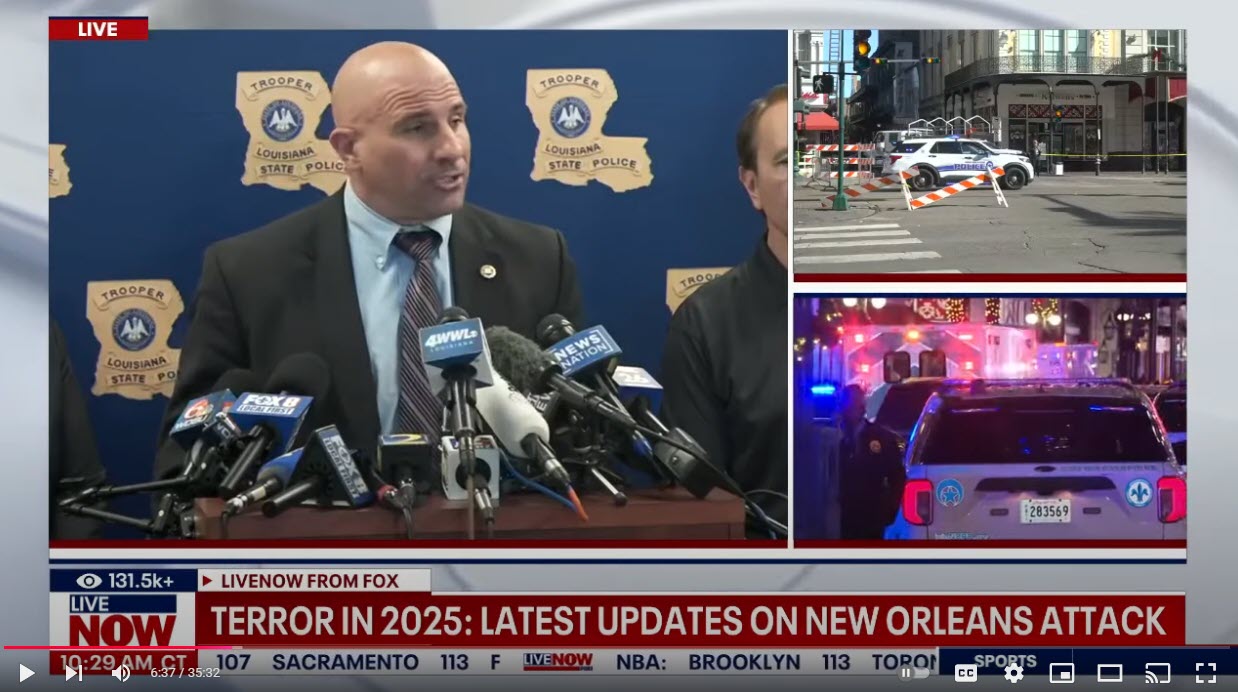
The FBI has officially classified the New Year’s Eve truck attack on Bourbon Street in New Orleans as an act of terrorism, unveiling chilling details about the motivations and actions of the perpetrator. The attack, carried out by Shamsud-Din Jabbar, a 42-year-old U.S. Army veteran and Texas resident, resulted in the deaths of 15 people and left over 30 others injured, many of whom remain hospitalized.
Jabbar, who was killed in a shootout with police shortly after the attack, acted alone, according to FBI officials. In a series of social media videos posted just hours before the incident, Jabbar pledged allegiance to the Islamic State (ISIS) and expressed his intent to commit violence. These videos, which investigators describe as disturbing, contained rhetoric about a “war between believers and disbelievers,” showcasing his radicalized beliefs. His journey from Texas to Louisiana was meticulously documented in surveillance footage, providing a clearer timeline of events leading up to the attack.
The attack unfolded in the early hours of January 1 on Bourbon Street, a popular destination for New Year’s celebrations. Witnesses reported a horrifying scene as Jabbar’s pickup truck barreled through a densely packed crowd of revelers. People screamed and scattered as the truck left destruction in its wake. Emergency responders and law enforcement were quick to arrive, but the damage had already been done. The chaos ended in a shootout between Jabbar and police officers, during which the suspect was fatally shot. His truck, which investigators later searched, contained an ISIS flag and several improvised explosive devices (IEDs). Fortunately, none of the devices were detonated.
The victims of the attack included locals and tourists, ranging in age and background, who had gathered to celebrate the New Year. The names of the deceased have not yet been officially released, but families and friends have begun to share stories of those lost. The injured, many of whom suffered severe trauma, are receiving treatment at New Orleans-area hospitals. Medical professionals are working around the clock to save lives and stabilize those in critical condition. Local residents have rallied to support the victims and their families, with vigils being held across the city to honor the memory of those killed.
The attack has sent shockwaves through New Orleans, a city known for its vibrant culture and welcoming spirit. Community leaders and residents are grappling with the profound loss while emphasizing resilience in the face of tragedy. Investigators are now focused on piecing together Jabbar’s background and motivations. Over 1,000 federal, state, and local law enforcement agents are involved in the case, which officials describe as one of the most significant domestic terrorism investigations in recent years. FBI Deputy Assistant Director Christopher Raia has urged the public to come forward with any information about Jabbar’s activities, particularly in the weeks leading up to the attack. Tips have been pouring in from across the country, providing leads for investigators to follow.
President Joe Biden addressed the nation, strongly condemning the attack and reaffirming the government’s commitment to combating terrorism in all forms. He expressed condolences to the families of the victims and praised the swift response of law enforcement and first responders. Louisiana Governor Jeff Landry echoed these sentiments, calling the attack a “heinous act of terrorism” and pledging the state’s full cooperation in the ongoing investigation. Officials have described the process of unraveling the details of the attack as akin to assembling a jigsaw puzzle, with each piece providing crucial insights into Jabbar’s motivations and actions.
Surveillance footage has been instrumental in shedding light on the events leading up to the attack. Videos captured Jabbar’s truck entering New Orleans and weaving through city streets before reaching Bourbon Street. His erratic driving patterns raised concerns from witnesses, some of whom reported the vehicle’s behavior to authorities before the incident occurred. Social media platforms have also been key in understanding Jabbar’s radicalization. Investigators are analyzing his online activity, including the videos he posted pledging allegiance to ISIS and articulating his extremist views.
The New Orleans tragedy has reignited national discussions about homegrown terrorism and the challenges of identifying individuals who pose a threat. Jabbar’s status as a U.S. Army veteran adds another layer of complexity, raising questions about the intersection of mental health, military service, and radicalization. Advocacy groups have called for increased resources to address these issues and prevent similar incidents in the future.
As the investigation continues, the nation mourns the lives lost and reflects on the broader implications of this act of terrorism. New Orleans, a city that has faced its share of challenges, is demonstrating resilience and unity in the wake of this senseless violence. Law enforcement remains vigilant, urging the public to stay informed and report any suspicious activity.
The attack serves as a stark reminder of the ongoing threat posed by extremist ideologies and the importance of community vigilance. While investigators work to uncover every detail about Jabbar’s actions and motivations, the focus remains on providing justice for the victims and ensuring the safety of all Americans.

