

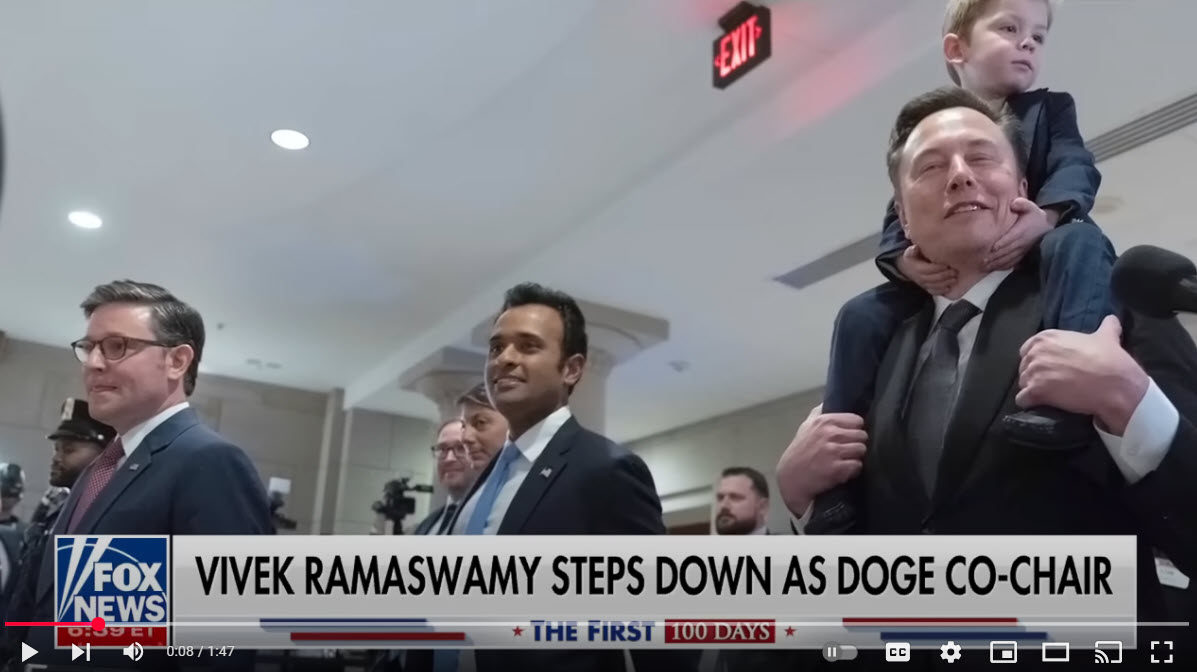
In a surprising turn of events, Vivek Ramaswamy announces his resignation as head of the Department of Government Efficiency (DOGE), handing the reins over to tech entrepreneur Elon Musk. The announcement is made during a live press conference, sparking widespread speculation about the direction DOGE will take under Musk’s leadership.
Ramaswamy, who has led DOGE since its inception, states that his decision to step down stems from a desire to focus on private sector innovation. Under his tenure, the department spearheaded numerous initiatives aimed at streamlining federal operations, reducing bureaucracy, and integrating advanced technologies into government processes. His resignation marks the end of an era characterized by bold policy reforms and tech-driven efficiency measures.
Elon Musk, the billionaire CEO of Tesla, SpaceX, and other ventures, is officially named as Ramaswamy’s successor. Known for his unconventional approach and visionary ideas, Musk takes over with a pledge to revolutionize the department’s mission. During his inaugural speech, Musk emphasizes his plans to incorporate cutting-edge artificial intelligence, blockchain technology, and space-based solutions to optimize government functionality. “Efficiency is not just a buzzword—it’s the key to unlocking a future where government serves the people with precision and speed,” Musk declares.
The decision to appoint Musk is met with mixed reactions. Supporters praise his entrepreneurial spirit and track record of disruptive innovation, expressing optimism that his leadership could transform DOGE into a model of 21st-century governance. Critics, however, voice concerns about Musk’s controversial past and question whether his ambitious vision aligns with the department’s core objectives.
Musk’s first order of business as head of DOGE is expected to involve a detailed audit of current projects, with plans to expand initiatives related to renewable energy integration and autonomous systems in public transportation. He also hints at launching a public interface powered by AI to enhance citizen engagement and streamline access to government services.
Ramaswamy expresses confidence in Musk’s ability to lead DOGE into its next chapter, describing him as “uniquely positioned to challenge the status quo and bring about meaningful change.” The outgoing leader also notes that he will continue to support DOGE’s mission from the private sector, where he intends to explore ventures in biotechnology and sustainable development.
As the transition unfolds, the spotlight remains on Musk’s leadership style and his capacity to balance innovation with practicality. The change at DOGE signals a bold new chapter for the department, one that promises to redefine the role of technology in governance.

