

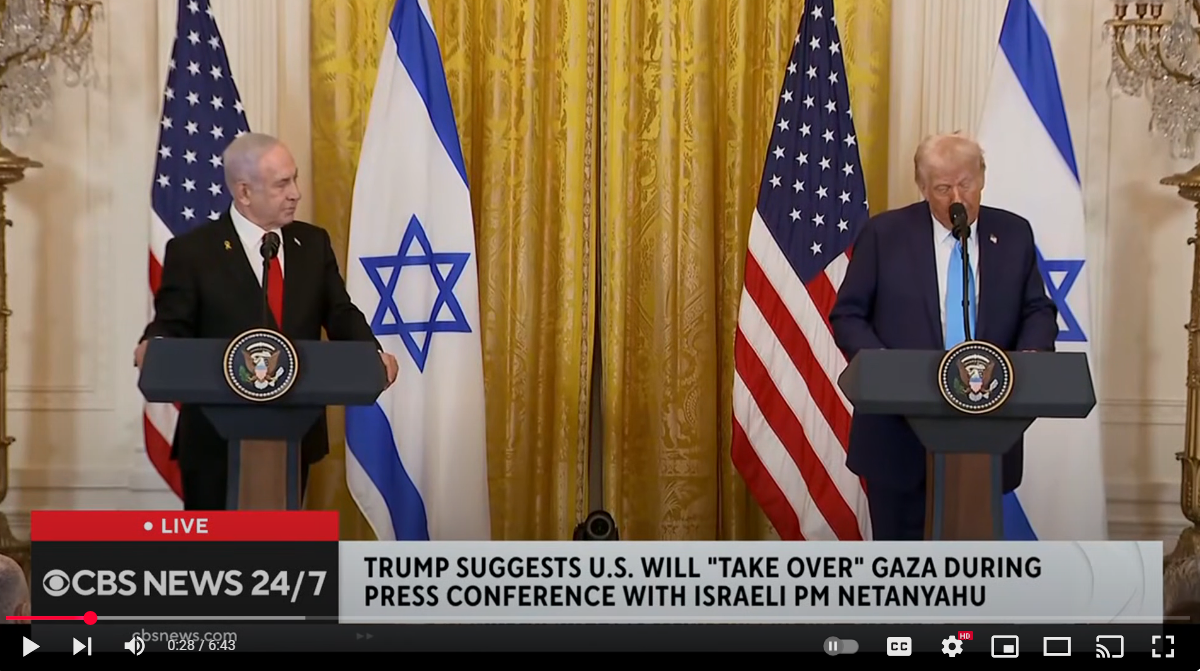
President Donald Trump announces that the United States will “take over the Gaza Strip” as part of an unprecedented plan to reshape the region following 15 months of conflict. Speaking at a joint press conference with Israeli Prime Minister Benjamin Netanyahu, Trump unveils his vision for rehabilitating the war-torn area, describing it as an opportunity to create the “Riviera of the Middle East.”
The proposal involves relocating Gaza’s approximately two million Palestinian residents to neighboring countries and using American resources to clear out the destruction left by the prolonged war. Trump suggests that nations such as Egypt and Jordan could permanently resettle displaced Palestinians, but both governments have publicly dismissed the idea. The plan also hints at possible U.S. military involvement, with Trump stating, “If it’s necessary, we’ll do that,” though he does not provide specifics on troop deployment.
Netanyahu fully endorses Trump’s plan, emphasizing its potential to permanently eliminate what he describes as a terrorist threat from Hamas. He expresses confidence that this approach will bring long-term security to Israel and allow for Gaza’s redevelopment under new governance. Trump highlights the need to remove all remnants of war from the region, calling for an aggressive rebuilding effort focused on economic growth, housing, and security infrastructure.
However, the proposal sparks immediate international backlash. Arab nations, including Saudi Arabia and Jordan, strongly condemn any forced displacement of Palestinians, warning that such an action would violate international law and escalate regional tensions. Palestinian leaders call the plan an outright attempt at ethnic cleansing, vowing to resist any attempts to remove people from their homeland. Hamas officials denounce the proposal, calling it “a blatant act of aggression that could ignite further conflict in the region.”
U.S. lawmakers are deeply divided. Republican allies of Trump praise the initiative as bold and pragmatic, arguing that it could finally resolve decades of instability. However, Democrats and some moderate Republicans denounce the plan as reckless and legally dubious, warning that it risks triggering a new humanitarian crisis. Senate Majority Leader Chuck Schumer criticizes the proposal, calling it “a dangerous and illegal maneuver that tramples on the rights of the Palestinian people and ignores the principles of international law.”
The United Nations issues a stern warning, stating that any forced displacement of Palestinians would be considered illegal under international humanitarian law. Human rights organizations echo these concerns, cautioning that the plan could set a precedent for mass expulsions and further entrench regional instability.
Trump’s proposal marks a drastic departure from traditional U.S. foreign policy, which has historically supported a two-state solution to the Israeli-Palestinian conflict. By advocating for a complete U.S. takeover of Gaza, Trump signals a shift toward a more unilateral and expansionist approach. Analysts suggest that this move could undermine existing peace efforts, further alienate U.S. allies in the Middle East, and provoke heightened tensions between Israel and its neighbors.
In a recent discussion on the “Judging Freedom” YouTube channel, Judge Andrew Napolitano and former Marine Corps officer Matt Hoh analyze President Donald Trump’s proposal for the United States to assume control over the Gaza Strip. They express concerns about the plan’s feasibility, legality, and potential humanitarian impact.
Hoh criticizes the proposal as a form of ethnic cleansing, highlighting the ethical and legal issues associated with forcibly relocating Gaza’s two million residents. He emphasizes that such actions would violate international law and likely exacerbate regional tensions.
Judge Napolitano raises constitutional concerns, questioning the president’s authority to unilaterally implement such a plan without congressional approval. He also discusses the potential for significant military involvement and the risks of entangling the U.S. in further Middle Eastern conflicts.
Both experts agree that the proposal could lead to increased instability in the Middle East and damage the United States’ international standing. They advocate for diplomatic solutions that respect the rights and sovereignty of the Palestinian people, rather than unilateral actions that could have far-reaching negative consequences.
Despite the mounting criticism, Trump remains firm on his stance, asserting that his plan offers the “best path forward” for Gaza. He dismisses accusations of human rights violations, arguing that the current state of Gaza is unsustainable and that the U.S. is uniquely positioned to transform the territory into a thriving economic hub.
As global leaders react to this unprecedented announcement, the future of the Gaza Strip remains uncertain. Whether Trump’s plan gains traction or faces insurmountable legal and diplomatic obstacles will be a defining issue in the months to come.

