

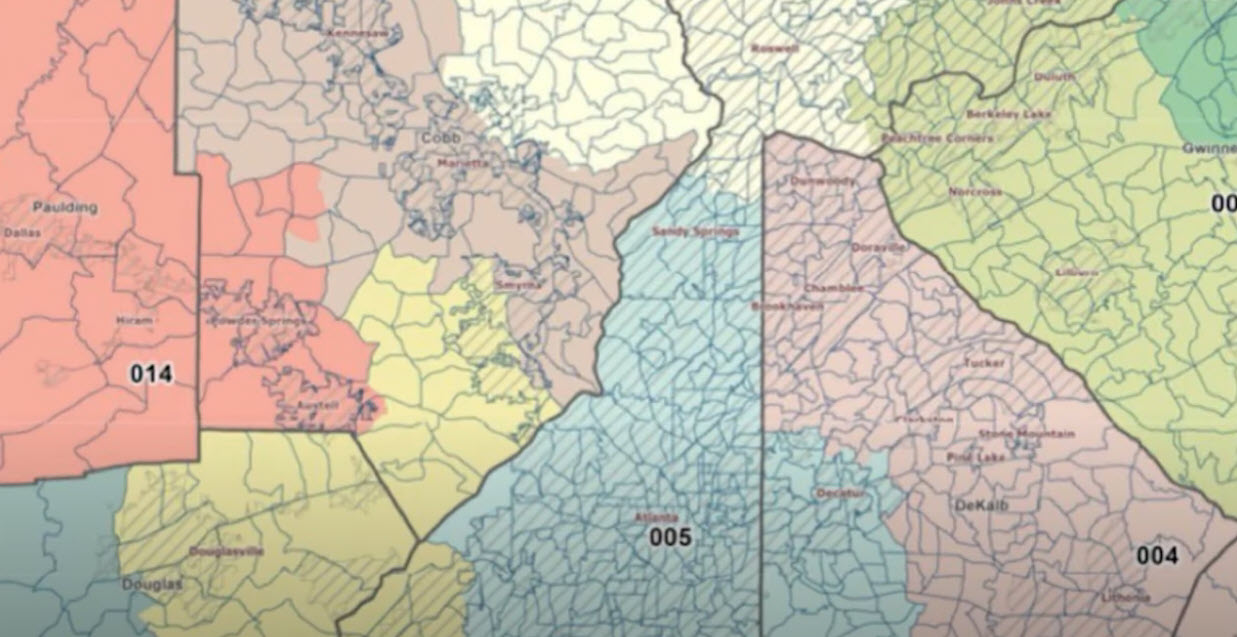
In a contentious decision, a federal judge has greenlit Georgia’s Republican-drawn congressional map, reigniting the debate about voter rights and partisan influence in the Peach State. The new map, crafted in response to a previous court order, adds a second Black-majority district to the Atlanta area, but Democrats and voting rights groups argue it still unfairly dilutes the power of minority voters.
Judge Steve C. Jones ruled that the revised map complies with his earlier order to rectify violations of the Voting Rights Act, which prohibits practices that suppress minority voting power. However, the decision left many unsatisfied.
Advocates for voting rights contend that the map, while adding a Black-majority district, manipulates other district lines to pack Black voters into fewer districts and disperse them in others, making it harder for them to elect their preferred candidates in general elections. This, they argue, effectively negates the addition of the new Black-majority district.
“While we are pleased with the creation of a second Black-majority district,” said Kristen Clarke, Assistant Attorney General for the Civil Rights Division, “we will continue to monitor the implementation of the map and its impact on voters of color.”
Republicans, on the other hand, praised the decision, claiming the map fairly reflects the state’s diverse population and complies with all legal requirements. “This is a fair map that accurately reflects the people of Georgia and ensures every voice is heard,” said Georgia Governor Brian Kemp.
The judge’s approval likely ensures Republicans will maintain their current edge in the state’s congressional delegation, holding nine of the 14 seats. Additionally, their majorities in both the state House and Senate are likely to remain intact.
This decision, however, is unlikely to be the last word on Georgia’s voting landscape. Legal challenges could arise, and the impact of the map on the 2024 elections will be closely scrutinized. The debate over fair representation and voting rights in Georgia is far from over, and the judge’s ruling is merely another chapter in this ongoing saga.
The fight for equitable electoral maps and access to the ballot box remains a crucial issue across the country. Georgia’s case serves as a microcosm of the nationwide struggle for voting rights, and the legal and political battles surrounding its congressional map will continue to be watched closely as the 2024 elections approach.

