

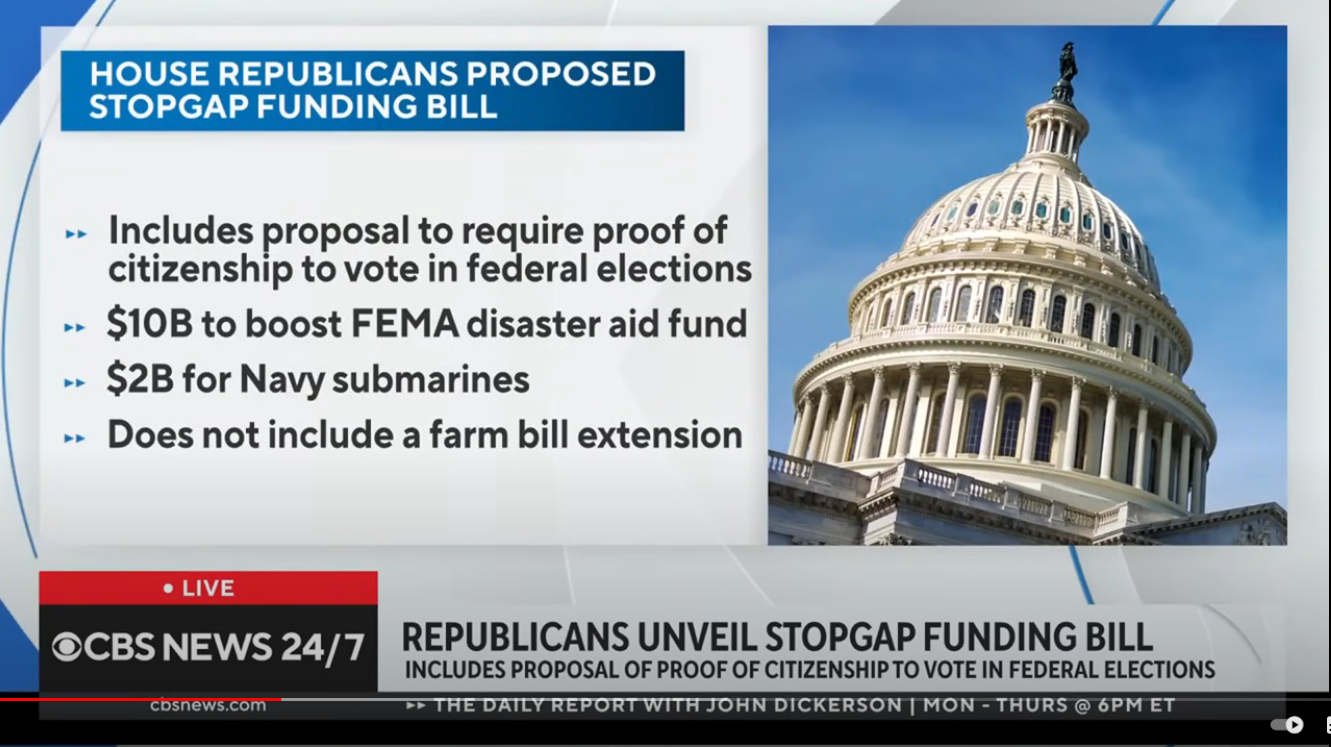
House Republicans have unveiled a stopgap funding bill aimed at averting a government shutdown by the October 1 deadline, but the proposal includes a controversial provision that would require proof of citizenship to vote in federal elections. Lawmakers returned to Capitol Hill this week after a six-week recess, with just weeks remaining to find a solution before government funding runs out on September 30. If no agreement is reached, the shutdown would result in the closure of federal agencies, national parks, and the furlough of millions of government workers, while limiting public services.
The proposed stopgap bill, which would temporarily fund the government, also introduces a requirement for voters to provide proof of citizenship at the ballot box for federal elections. This push for stricter voting regulations, led by Texas Republican Congressman Chip Roy, is part of the GOP’s effort to bolster election security. However, the measure is facing sharp opposition from Democrats, including Texas Congressman Lloyd Doggett, who argues that the proposal would create chaos, especially so close to an election year.
Doggett voiced concerns that the proof-of-citizenship requirement could disenfranchise voters and make it harder to cast ballots in a system that already has safeguards against non-citizens voting. He emphasized that it is already illegal for non-citizens to vote and that changing voter registration laws ahead of the 2024 election could lead to confusion and delays.
The stopgap bill, known as a continuing resolution, is crucial to avoid a government shutdown as Congress remains far from reaching a consensus on a comprehensive yearlong funding bill. The GOP’s proposed voter requirements are likely to face stiff resistance in the Democratic-controlled Senate, where lawmakers have already signaled that the provision will not survive.
As the November election approaches, the political battle over voting rights and government funding is intensifying. The inclusion of the citizenship requirement is expected to be a key sticking point in the negotiations, as both parties seek to balance election security with voter accessibility.
The clock is ticking for Congress to pass a funding solution, with the threat of a shutdown looming. If no stopgap measure is approved, the effects could ripple across the country, from closed parks to stalled federal programs, as well as economic consequences for government workers and contractors.

