

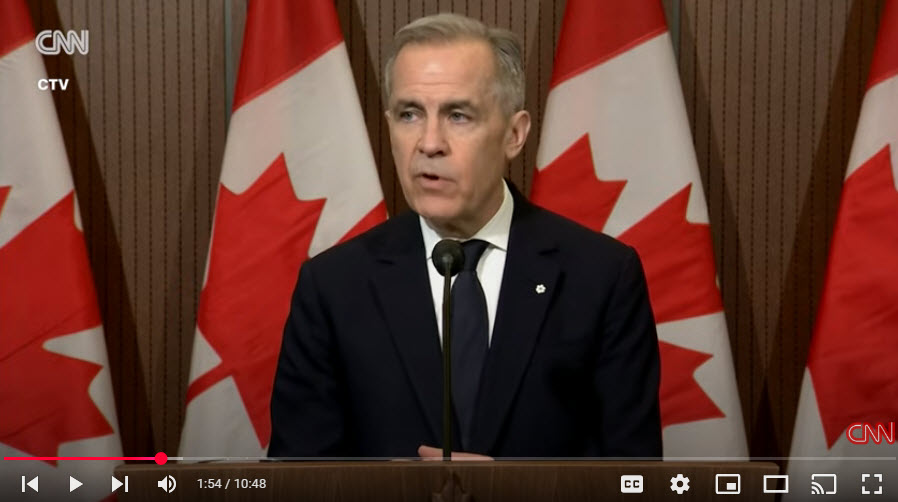
In Washington, DC, and Ottawa, a rare bipartisan effort in the U.S. Senate is making waves on April 3, 2025, as a resolution spearheaded by Minnesota Senator Amy Klobuchar to undo President Donald Trump’s 25% tariff on most Canadian imports narrowly passes the upper chamber. The measure, which secures a 51-48 vote late on April 2, sees four Republican senators—Rand Paul and Mitch McConnell of Kentucky, Susan Collins of Maine, and Lisa Murkowski of Alaska—join all 47 Democrats in a symbolic rebuke of Trump’s trade policy. Meanwhile, Canadian Prime Minister Mark Carney, speaking from Ottawa, announces counter auto tariffs on U.S. imports in response to Trump’s sweeping tariff rollout on Wednesday, warning that the global economy is now “fundamentally different” and that the pain of these trade measures will reverberate worldwide.
The Senate resolution, co-authored by Senators Tim Kaine of Virginia and Mark Warner of Virginia alongside Klobuchar, aims to terminate the national emergency declaration Trump invoked on February 1, 2025, under the International Emergency Economic Powers Act (IEEPA). Trump uses this declaration to justify the tariffs, claiming they address fentanyl trafficking and illegal immigration from Canada—a rationale widely disputed by critics. Klobuchar, speaking on the Senate floor before the vote, emphasizes the economic toll on her state, noting, “Any tariff on Canada would hurt Minnesota by driving up prices and eliminating jobs.” She frames the resolution as a stand against the misuse of emergency powers, stating, “This resolution is about drawing a line in the sand and saying you cannot abuse your emergency powers to start an unjustified trade war.” The resolution’s passage, though largely symbolic, marks the most significant bipartisan pushback against Trump’s trade agenda since his second term began in January 2025.
The four Republican senators who break ranks with Trump face intense pressure from the president, who takes to Truth Social on April 1 to urge them to oppose the measure, calling them “disloyal” and claiming the tariffs are necessary to curb fentanyl flows from Canada. However, federal data undermines this justification: U.S. Customs and Border Protection reports seizing just 19 kilograms of fentanyl at the northern border in fiscal year 2024, compared to over 9,500 kilograms at the southern border. Senator Collins, in a floor speech, highlights the economic integration between Maine and Canada, warning that tariffs would jeopardize industries like paper mills, which employ over 500 people in rural areas. McConnell, a longtime tariff skeptic, calls the levies “a tax on everyday working Americans,” pointing to retaliatory measures already impacting Kentucky’s bourbon industry. Paul, a co-sponsor of the resolution, argues that tariffs violate constitutional principles, stating, “Our Founding Fathers said it would be illegal for one person to raise taxes. It has to come to Congress.”
Despite the Senate’s action, the resolution’s future is uncertain. The Republican-controlled House, led by Speaker Mike Johnson, is unlikely to bring the measure to a vote, with Johnson having already moved to block similar efforts to challenge Trump’s emergency declarations. Posts on X reflect a mix of optimism and skepticism, with some users praising the bipartisan effort while others note its limited impact given the House’s stance. The U.S. Chamber of Commerce, several unions, and groups representing retailers and manufacturers endorse the resolution, with the Chamber’s CEO Neil Bradley stating, “Tariffs are taxes—paid by Americans—and they will quickly increase prices at a time when many are struggling with the cost of living.”
Across the border, Canadian Prime Minister Mark Carney delivers a sharp response to Trump’s tariff announcement on April 2, dubbed “Liberation Day” by the White House. Trump unveils a 10% baseline tariff on all imports, with higher reciprocal rates on over 180 countries, including 34% on China, 20% on the EU, and 46% on Vietnam. While Canada is spared new tariffs in this latest round, the existing 25% tariff on most goods and a 10% tariff on energy imports—imposed in February—remain in place. Carney announces counter auto tariffs on U.S.-imported cars, adding to previously enacted retaliatory measures from March 2025, which target $30 billion in U.S. goods with plans to expand to $125 billion over 21 days. In a press conference, Carney warns, “The impact of tariffs announced by Trump will be felt around the world,” adding that the global economy is now “fundamentally different” than it was before the announcement. He expresses skepticism about Trump’s willingness to reverse course, stating, “I don’t believe Trump will change direction until the pain felt by Americans due to the tariffs will be too hard to ignore.”
The historical context of U.S.-Canada trade relations underscores the stakes. Canada is the U.S.’s largest trading partner, with bilateral trade valued at $1 trillion annually as of 2024, according to the U.S. Trade Representative. Minnesota, as Klobuchar notes, relies heavily on this relationship, with Canada being its top export market—$7.5 billion in goods in 2023 alone, per the Minnesota Department of Employment and Economic Development. The U.S.-Mexico-Canada Agreement (USMCA), renegotiated during Trump’s first term and implemented in 2020, was meant to strengthen North American trade, but Trump’s tariffs threaten to unravel these gains. During his first term, Trump’s 2018 tariffs on Canadian steel and aluminum led to a 10% drop in U.S. exports to Canada, according to a 2019 report from the U.S. International Trade Commission, and prompted Canada to impose $12 billion in retaliatory tariffs on U.S. goods like whiskey and maple syrup.
The broader economic fallout from Trump’s latest tariffs is already evident. On April 2, the S&P 500 drops 4%, its worst day since September 2022, while the Dow Jones Industrial Average falls over 1,500 points, and the Nasdaq Composite declines 5.2%. Companies like Stellantis, which produces Jeep and Chrysler vehicles, announce production halts at plants in Windsor, Ontario, and Toluca, Mexico, due to the trade uncertainty. Economists warn of dire consequences: Moody’s Analytics predicts a potential 2% hit to U.S. GDP growth and inflation nearing 5%, while Goldman Sachs slashes its S&P 500 year-end target to 5,700 from 6,500. Consumer confidence, already at a 12-year low in March 2025, continues to erode as retailers like Best Buy warn of price hikes.
Breaking news updates as of 11:43 AM PDT on April 3 reveal further developments. The UK, under Prime Minister Keir Starmer, launches a consultation on retaliatory tariffs against the U.S., though Starmer emphasizes ongoing trade deal talks. Oxford Economics cuts its UK growth forecast to below 1% for 2025, citing the global trade slowdown. In the U.S., House Democrats, led by Representative Gregory Meeks of New York, are pushing a privileged resolution to force a vote on the tariffs, aiming to bypass GOP leadership. Meanwhile, Trump doubles down, with a White House statement on April 3 asserting that the tariffs will “secure our borders and stop the scourge of fentanyl,” despite evidence to the contrary.
The Senate’s resolution and Canada’s counter tariffs highlight the growing tension in U.S.-Canada relations, a partnership long considered a cornerstone of North American stability. While the resolution signals bipartisan unease with Trump’s trade war, its symbolic nature and the House’s resistance suggest that the tariffs—and their economic fallout—will persist. As Carney predicts, the global economy is indeed on a new trajectory, one marked by uncertainty, retaliation, and a deepening divide over the future of international trade.
Sources:
- Video: [Link unavailable as per instructions]
- Star Tribune, “GOP legislators join Democrats in passing Klobuchar’s resolution to undo Trump’s tariff on Canadian imports,” April 2, 2025
- NBC News, “Senate passes measure to revoke new Canada tariffs as four Republicans break with Trump,” April 2, 2025
- CNN Politics, “Four Senate Republicans join with Democrats to rebuke Trump tariff policy in key vote,” April 2, 2025
- Politico, “GOP senators line up with Democrats to oppose Trump’s Canada tariffs,” April 1, 2025
- The New York Times, “Senate Votes to Rescind Some Trump Tariffs, With G.O.P. Support,” April 2, 2025
- CBS News, “4 Republicans join Senate Democrats to rebuke Trump tariffs on Canada,” April 2, 2025
- NPR, “Senate rebukes Trump’s tariffs on Canada,” April 2, 2025
- The Guardian, “Republicans join Democrats in Senate vote to rescind Trump Canada tariffs,” April 2, 2025
- U.S. Senator Tim Kaine, “Kaine, Klobuchar, and Warner Announce Expected Vote Timing on their Bill to Undo Canada Tariffs that will Raise Costs,” March 28, 2025
- NBC News, “Senate narrowly passes measure rebuking Trump on trade after new tariffs are announced,” April 2, 2025
- MSNBC, “Snubbing Trump, bipartisan group of senators votes against Canada tariffs,” April 2, 2025
- AP News, “Senate rebukes Trump’s tariffs as some Republicans vote to halt taxes on Canadian imports,” April 2, 2025
- PBS News, “WATCH: Senate passes resolution to undo Trump’s Canada tariffs in rare Republican rebuke,” April 2, 2025
- U.S. Senator Amy Klobuchar, “On Senate Floor, Klobuchar Calls for Congress to Pass Her Legislation to Reverse Canada Tariffs,” March 31, 2025
- CBC News, “Small group of Republicans join Democrats to rebuke Trump on Canadian tariffs in Senate vote,” April 2, 2025
- Politico, “Senate Republicans buck Trump, join Dems in rejecting Canada tariffs,” April 2, 2025
- Newsweek, “List of Republican Senators Who Voted to Thwart Trump’s Canada Tariffs,” April 2, 2025
- Politico, “McConnell breaks with party to reject Trump’s Canada tariffs,” April 2, 2025
- Fox News, “Senate sounds off on resolution to cancel Trump Canada tariffs,” April 2, 2025
- U.S. Senator Amy Klobuchar, “On Senate Floor, Klobuchar Calls for Congress to Pass Her Legislation to Reverse Canada Tariffs,” April 2, 2025
- National Post, “Four Senate Republicans vote against tariffs on Canada,” April 2, 2025
- Axios, “Senate votes to repeal Trump’s Canada tariffs,” April 2, 2025
- The Hill, “4 GOP senators vote with Democrats to undo Trump tariffs on Canada,” April 2, 2025
- Politico, “GOP senators vs. Trump on tariffs,” April 1, 2025
- U.S. Trade Representative, “U.S.-Canada Trade Facts,” 2024
- Minnesota Department of Employment and Economic Development, “Minnesota Exports to Canada,” 2023
- U.S. International Trade Commission, “Economic Impact of Section 232 and 301 Tariffs on U.S. Industries,” 2019

